How to Read NEC Table 310.16 Without Losing Points
The ampacity table is the most-used table on the licensing exam and the one candidates misread most often. Here is the column-by-column method, plus the three corrections the exam expects you to apply.
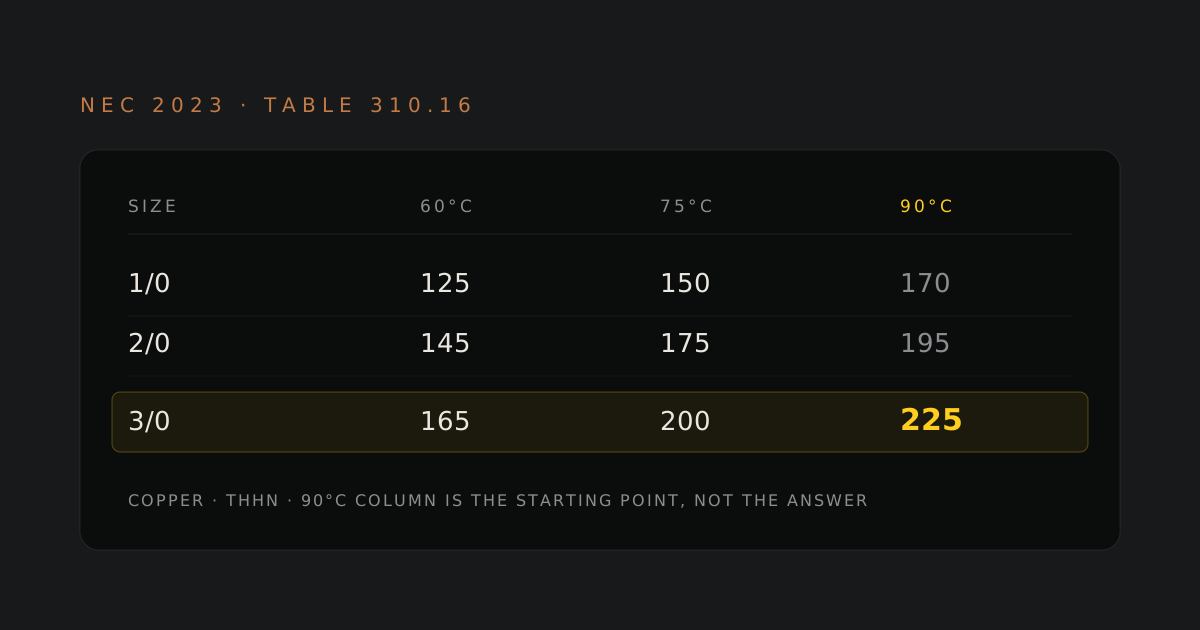
Table 310.16 is the table you will open more than any other on exam day. It is also the table that quietly costs people points — not because the numbers are hard to find, but because candidates stop reading one line too early.
Here is how I teach it.
Read the header before the number
Every column in Table 310.16 sits under a temperature rating — 60°C, 75°C, or 90°C — and every block of rows sits under a conductor material, copper or aluminum. Before you look for an ampacity, you should already know two things:
- Is the conductor copper or aluminum?
- What temperature column does the question send you to?
If the question does not name a column, it is usually testing whether you know the
termination rule instead. That is 110.14(C), and it is the single most common reason a
correct table lookup still produces a wrong answer.
The 90°C column is a starting point for correction math. It is almost never your final answer for a terminated conductor.
The three corrections
Once you have a base ampacity out of the table, the exam expects you to apply corrections in a fixed order. Miss the order and the arithmetic still lands somewhere wrong.
| Step | What it does | Where it lives |
|---|---|---|
| Ambient temperature correction | Adjusts for conditions above or below 30°C | 310.15(B)(1) |
| Conductor bundling adjustment | Adjusts for more than three current-carrying conductors | 310.15(C)(1) |
| Termination limit | Caps the result at the equipment's rating | 110.14(C) |
The first two are multipliers applied to the table value. The third is not a multiplier — it is a ceiling. You do the math, then you check the ceiling.
A worked example
A 3/0 AWG copper THHN feeder, 6 current-carrying conductors in a raceway, 40°C ambient, terminating on equipment rated for 75°C.
Base (90°C column, 3/0 Cu)     225 A
Ambient correction @ 40°C      × 0.91
Bundling adjustment (4–6)      × 0.80
                               ───────
Corrected ampacity             163.8 A

Termination ceiling (75°C col) 200 A   → not binding
Final usable ampacity          163.8 A
You started in the 90°C column because that is what the conductor insulation is rated for, and that is the value the corrections apply to. The 75°C column only showed up at the end, as a ceiling — and here it did not bind.
Where the exam sets the trap
Three patterns account for most of the lost points:
- Starting in the wrong column. A question that mentions THHN and then asks for
a terminated ampacity is testing
110.14(C), not your ability to read a row. - Counting the neutral wrong. Whether the neutral is a current-carrying conductor
changes the bundling multiplier. Check
310.15(E)before you count. - Applying the ceiling first. Cap at the end. Capping early throws the correction math off and produces an answer that will be on the list of choices.
Practice it under time
Reading the table correctly once is not the skill. Reading it correctly in ninety seconds, on the fourth question in a row, is. That is what the timed practice sets are for — work the ampacity questions until the column check happens before you reach for a number.
10 questions across grounding, load calculations, wiring methods, and general requirements. Instant score breakdown. Find out where you stand before exam day — free, no account required.
Take the Readiness Check →